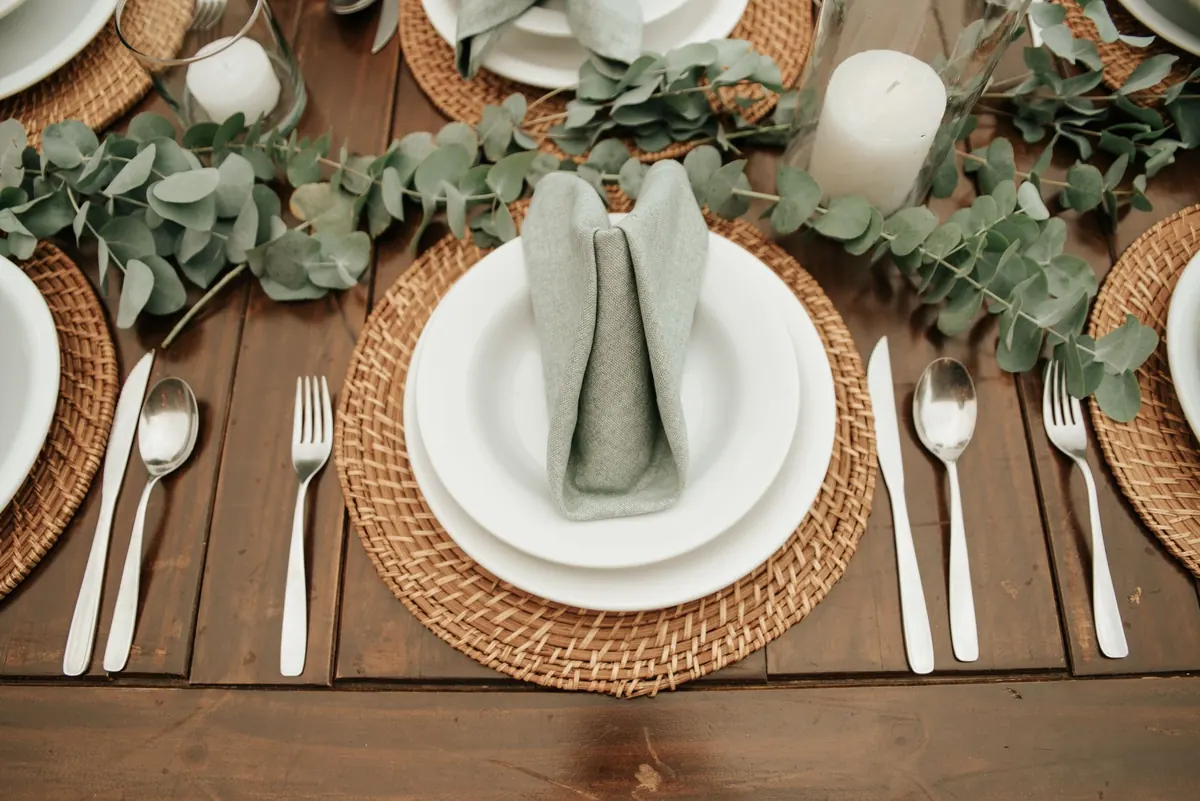
A rustic table doesn't need a theme. It needs a few honest materials, a bit of height, and enough bare surface left over that someone might actually sit down and eat. Linen does the softening. Rough wood gives the table a spine. Whatever you gather from the garden, the hedgerow or the back of a cupboard supplies the irregularity that makes the whole thing look settled rather than styled.
The difficulty is scale and restraint. A runner that stops short of the edge, a branch that's too tall for the ceiling, a bowl too small for the table: these are the small misjudgments that make a centerpiece look fussy. Here is how to build one from the cloth outward, with adjustments for the dining room, the kitchen and the porch.
Begin with the Cloth, Not the Centerpiece
Most rustic tables go wrong at the first step, when someone buys a cloth that covers the whole thing. Leave the wood visible. A runner is doing its job when it reads as a band of texture down the middle rather than a fitted cover, and the bare timber on either side is half the effect.
Measure the length of the table, then add 16 to 20 inches so the linen can fall 8 to 10 inches over each end. Narrow runners, roughly 14 to 18 inches wide, suit long farmhouse tables; go wider, up to 24 inches, if your table is short and you want the runner to carry more of the visual weight. If you fall in love with a length that's slightly too long, fold one end under rather than cutting it. Linen is forgiving that way.
Choose a medium-weight washed linen or a linen-cotton blend. Thin, crisp fabric looks formal and fights the wood; heavier weaves drape softly and shrug off wrinkles. Wash new linen once in warm water without fabric softener, then press it on the reverse while it's still damp, with a hot iron. A light spray of water and thirty seconds of steam will do more than any product. Keep a second, darker runner for everyday use and save the pale one for evenings when the table is set for guests.
Give the Wood Some Room
Rough wood works best as a low platform laid along the centerline: a reclaimed board, a shallow dough bowl, an old cutting board, a slice of a fallen trunk. This is the element that keeps a linen runner from floating and gives everything above it somewhere to sit.
If you're bringing in salvaged timber, sand it just enough to stop splinters catching on cloth, around 120 grit, and leave the saw marks alone. Seal it with a food-safe oil and beeswax blend if plates will touch it directly; use a hardening oil if it's purely decorative. Felt pads underneath protect the tabletop, and a coaster under any vase holding water is not optional, since a damp ring on an oiled board will bloom into a pale mark that never quite leaves.
Aim for one large wooden piece rather than several small ones. A single board running most of the table's length creates a line the eye follows; three small trays scattered about create clutter.
Gather Instead of Shop
The natural accents should look like they arrived by accident. That means fewer, bigger gestures and a willingness to let things be lopsided.
Good things to gather, depending on the season and where you live:
- Dried hydrangea heads, allium seed pods, nigella, poppy pods
- Branches of olive, eucalyptus, bay or rosemary, cut short
- Wheat, oats or barley stems, bunched and tied with twine
- Birch twigs, pinecones, sweetgum balls, sycamore cases
- Smooth stones, a piece of driftwood, a chunk of moss
- Quince or crab apple branches with a few leaves still attached
Cut in dry weather, ideally mid-morning once the dew has lifted, and ask before you take anything that isn't yours. Skip whatever is protected, flowering, or the only specimen in sight. Woody stems should be cut at an angle and given a few hours in deep water before they come indoors. For dried material, strip the lower leaves and hang the stems upside down in a dark, airy room for a week or two; they'll hold their shape far longer than anything dried in a warm oven or a sunny window.
Once indoors, arrange in odd numbers and uneven heights. Three stems of different lengths in a stoneware jug will look better than a dozen matched ones in a vase.
Layer from the Bottom Up
Work in a fixed order and the table will build itself. Try this sequence the first few times:
- The cloth. Runner centered, pressed, ends falling evenly.
- The wood. One board or bowl, placed slightly off-center so the table doesn't look measured.
- The height. One tall element and one low one, at opposite ends of the runner or in a loose diagonal. Never five.
- The soft layer. Folded napkins, a length of raw-edged linen, a wool scarf, a stack of old plates.
- The found layer. Stones, a jar of dried stems, a single pinecone, a candle in a dish.
- The gaps. Take something away. Then leave the bare patches alone.
The last five percent is what separates a styled table from a set one: a sprig laid casually across a napkin, a chipped enamel jug, a candle burned down on one side. Resist the urge to correct these.
Three Tables, Three Approaches
The dining room
Keep the centerpiece below eye level when people are seated, roughly the height of a wine glass, or push the tall element to one end so it never blocks a conversation. Two low arrangements flanking a single lit candle are more effective than one crowded center. Use your best linen here, and iron it. This is the room where a crisp fold earns its keep.
The kitchen table
This table works harder, so build it to be cleared in one movement. A tray holding salt, oil, a small jug and a bowl of lemons is a complete tablescape; so is a board with bread, a pot of herbs and a folded cloth. Choose a darker runner that hides the occasional splash, and keep the wood element practical rather than precious.
The porch or garden table
Wind and damp change the rules. Weight the runner with stones or a heavy wooden board at each end, use enamel and terracotta rather than glass, and choose lanterns over open candles. Rustic linen with a visible weave looks better outdoors than anything smooth, and a slightly frayed edge reads as intentional once you're under the sky.
Set It, Then Step Back
Before you call a table finished, walk to the doorway and look at it from the distance a guest will. If your eye lands on three or four things in a clear line, it's working. If it lands on nine, remove three and try again.
Keep a shallow box for the gathered material, a drawer for candles and matches, and a shelf for the boards. A table you can reset in five minutes gets reset; one that requires an hour of arranging slowly stays bare. Change the naturals with the seasons, leave the cloth and the wood alone, and let the small irregularities accumulate. That is what makes a rustic table look lived on rather than staged.
Photo: Jonathan Borba / Pexels